

ortelgarden
Symplocarpus foetidus
Symplocarpus foetidus
Couldn't load pickup availability
|
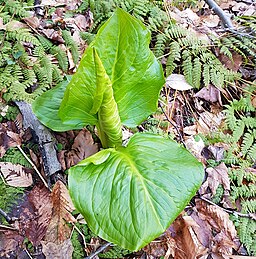
A lower-growing plant that grows in wetlands and moist hill slopes of eastern North America. Very early blooming. Bruised leaves present an odour reminiscent of skunk. Skunk cabbage is one of just a few plants that exhibit thermogenesis, the ability to metabolically generate heat, by cyanide resistant cellular respiration. Since plants can bloom while snow and ice remains on the ground, the spadix can generate temperatures on average 20 degrees warmer inside the spathe than the surrounding air temperature for nearly two weeks, even keeping the temperature constant and optimal for flower maturation and pollination. The spathe never opens properly, but protects the oval-shaped, yellowish to purple spadix. Many small flowers are tightly packed on the 5-10cm long spadix. Each individual petal-less flower has four inconspicuous, fleshy, straw-colored sepals that never unfold. The stigmas (female parts) are the first out, then the stamens at the base of each stigma, preventing self-pollination. Each rolled, bright green leaf unfurls like a scroll to expose the next leaf. It will form a rosette of wavy edged leaves up to 90cm in good conditions.Even the petiole ends up 30cm long. Evidently the foliage is rich in calcium oxalate and causes irritation of the mouth and throat if ingested. Some animals, such as bear and some birds, will eat the buds or very young leaves as they are unfurling. Once the leaf canopy extends over the plants, they crumple and disappear to be dormant in summer and winter. Skunk cabbage was used medicinally by Native Americans and in the 19th century was listed in the U.S. Pharmacopoeia as the drug “dracontium” for the treatment of respiratory diseases, nervous disorders, rheumatism, and dropsy. It is found in moist habitats, including marshy deciduous woods, wet thickets, swamps, near springs, alongside streams and wetlands, by seeps, and in bogs, where it is often in bloom well before the snow melts. It is hard to shift due to a very fibrous root system. leaves 30cm Image of "flowers" in vase by Dennis Chang at the NZAGS Show at the Botanical Expo in September. Fritzflohrreynolds, CC B Leaf: Maria Aleshina, CC BY-SA 4.0 <https://creativecommons.org/licenses/by-sa/4.0>, via Wikimedia Commons COMING |