

ortelgarden
Hepatica transsilvanica
Hepatica transsilvanica
Couldn't load pickup availability
A hardy, long-lived alpine perennial with larger blue flowers and semi-evergreen, scalloped leaves. It spreads by slender rhizomes, forming elegant patches under deciduous shrubs, in rock gardens, or alpine troughs, thriving in sun to part shade with well-drained, neutral to mildly alkaline soil.
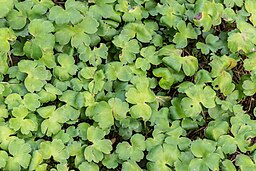
Found mainly in the Carpathian Mountains of Romania, this has larger flowers and three-lobed semi-evergreen foliage. Blue is the commonest colour, and are more tolerant of drier, sunnier positions – although they don’t like to dry out completely. They come from calcerous woodlands, so like neutral to mildly alkaline soils. The images of the flower and leaf variation are from John Massey and Tomoo Mabuchi's amazing book on Hepaticas.
NB H. nobilis along with other European types such as H. nobilis var. pyrenaica, (from the Pyrenees) H. transsilvanica and H. x media (hybrids are known as this), are among the most reliable selections to grow as garden plants and the only ones we can source in NZ.
They are excellent for planting under deciduous shrubs and trees, or in a rock garden, alpine trough or container, John Massey has them as kokedama! But they need shade in late spring once flowering has finished. They doo need sun in winter and and early spring. Take care not to plant them with neighbours that will overcrowd them.
H. nobilis and this species readily form hybrids, as their geographic zones overlap and they have been bred by gardeners for a long time.
However the origins of this species go back millions of years...
H. transsilvanica is an evolutionary hybrid . Molecular phylogenetics have confirmed that it is an allotetraploid, meaning it formed from two different parent species whose chromosome count has doubled. Its maternal parent is H. nobilis, the widespread European species with entirely lobed leaves, while its paternal parent is the white flowered H. falconeri, native to Central Asia (Kyrgyzstan, pakistan and Kashmir)with crenate or scalloped leaves.
To really get into it, this hybrid origin is evidenced by several lines of genetic research. Analysis of nuclear DNA sequences shows patterns consistent with contributions from both parent species, while the plant's plastid (mitochondrial) DNA is only inherited from the egg or maternally, closely matches that of H. nobilis. The hybrid nature is further supported by the plant's intermediate leaf morphology and its tetraploid chromosome count (n=28), compared to the diploid count (2n=14) of H. nobilis.
Dating analyses suggest this hybridization event occurred about 3 million years ago, during the late Pliocene. This makes H. transsilvanica substantially older than many European plant species, with its origin predating the major Quaternary glaciation cycles that reshaped much of Europe's flora. So it has significant importance due to its restricted distribution and ancient lineage. Unlike its widespread parent H. nobilis, it is found only in the Southeastern Carpathians of Romania, where it has persisted for millions of years. This helps support evidence that this area was a refuge for ancient plant lineages during dramatic climatic changes.
Flower: Magnus Hagdorn from UK, CC BY-SA 2.0 <https://creativecommons.org/licenses/by-sa/2.0>, via Wikimedia Commons
Lobed leaves: Krzysztof Ziarnek Kenraiz, CC BY-SA 4.0 <https://creativecommons.org/licenses/by-sa/4.0>, via Wikimedia Commons
Massed leaves of the rhozomatous plant: Krzysztof Golik, CC BY-SA 4.0 <https://creativecommons.org/licenses/by-sa/4.0>, via Wikimedia Commons
| Feature | Hepatica nobilis | Hepatica transsilvanica |
| Growth Habit | Forms tight clumps due to short rhizomes. | Patches rather than tight clumps. Spreads more quickly by tough, creeping, long slender rhizomes. |
| Leaves | Leaves are dark glossy green often with paler or even silvery markings. They have sparce furriness (pubescent) above, but densely so below. They have entire (smoother) margins and three rounded lobes. | Leaves are distictly larger and have quite notched or crenate (scalloped) margins. The leaves are always green and have sparse furriness (pubescent) on top and villous or long shaggy hairs beneath |
| Perianth | Typically 5-12 petalloids (sepals), most often 6 and sometimes 7. Each is 7-14 mm long and similar widths. Both species leaves are produced before of after the new leaves. Up to 30 carpels. | Generally has more petals than H. nobilis. (8-11). Each is 15-18 mm long and similar widths. Both species leaves are produced before of after the new leaves. Fewer carpels |
| Flower Colors | Blue-violet, pink, or white; Stamens: filaments white, anthers white or yellow. | Predominantly blue; anthers are white but filaments of the stamens are blue/purple. |
| Flowering times (Northern hemisphere) | March - May | March - April, so slightly longer. |
Share