

ortelgarden
Eryngium maritimum
Eryngium maritimum
Couldn't load pickup availability
A super tough little sea holly, happiest in dry sun or a pot of gravel. No mollycoddling here or you will loose it.
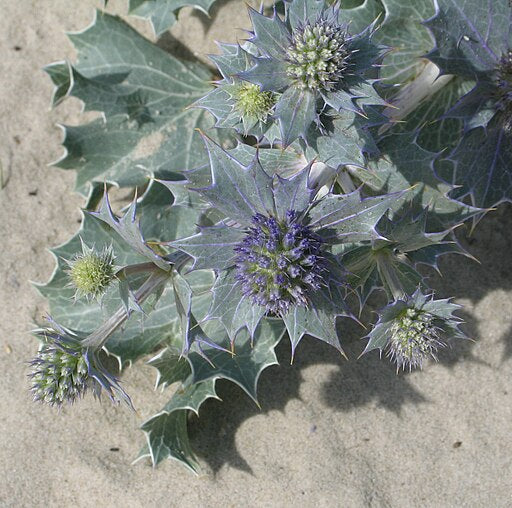
Native to the coastal regions of Europe and the Mediterranean, the UK and extending into parts of Western Asia. This is a vey hardy sea holly. A long lived perennial forms rosettes of bright green foliage followed by spiked spikes in a gorgeous blue head. (not much really) A unique dwarf for the front of borders, if they are dry and sunny.
Looking at the images of it in its natural environment, you can see it won't thrive jammed in amongst the border with too much water and too much of everything really! Try it in a pot where you can set up the conditions to suit. Perfect for a sand bed or shingle garden. 45cm
The Guardian’s lyrical writing by Andy Byfield is one of the founders of the wild plant charity Plantlife. It’s an interesting article. I hope it is ok to share his information and descriptions here since I can’t add an actual link for you to make access easy.
https://www.theguardian.com/lifeandstyle/gardening-blog/2012/aug/31/sea-holly-sand-dunes
He wrote about degraded grass-invading dunes in the UK such that rarer specialists like E. maritimum is becoming rare.
“Just such a plant is the sea holly (Eryngium maritimum), an architectural beauty of the sandy beaches and sand dunes around our shores. The plant's central cone of flowers is reminiscent of members of the daisy family, such as echinacea or rudbeckia, but sea holly is a relative of the carrot. The ruff of petals is actually a ring of spiny bracts that encircle and protect the flowers like the plates of a Stegosaurus or the frills of a Triceratops. The whole plant is a metallic blue-green, seemingly verdigrised like a bronze garden statue in miniature.
Sea holly is supremely adapted to growing in mobile sand. Its deep-seated rootstock penetrates the substrate to a depth of 1m or more, and the plant takes a masochistic delight in being buried by an avalanche of sand. It positively thrives under such treatment, making it a somewhat difficult plant to please in gardens: if you want to recreate the seaside look in your flowerbeds, stick to easier relatives, such as Eryngium bourgatii, E. giganteum, E. x oliverianum and E. x zabelii. These plants are perfectly happy under normal garden conditions - although they perhaps thrive and look at their best in poorer soils - so you don't have to buy a bit of the beach at Dungeness (like the late Derek Jarman), or indeed need to live near the coast, to create the look.”
Photograph on the shore of Mediterranean Sea near mouth of Dalyan River, Turkey, work by Radomil , Wikimedia Commons
Robert Flogaus-Faust, CC BY 4.0 <https://creativecommons.org/licenses/by/4.0>, via Wikimedia Commons
Share